Guide
Pellet smoker temperature guide: settings, internal temp, and rest
A pellet smoker holds its set temperature, but the food's story is told by its internal temperature, not the dial and not the clock. Pellet Smoker Mastery by Dale Hartwell includes temperature references, internal doneness guidance, and rest times designed to be consulted mid-cook. Here is the framework the book teaches.
The dial is a setting, not a verdict
The book connects smoker settings to outcomes rather than treating them as instructions. A set temperature tells you the fire's behavior; the food's internal temperature, read with a probe or instant-read thermometer in the thickest edible portion, tells you where the cook actually stands.
Why cooking time is only an estimate
Food thickness, starting temperature, smoker behavior, weather, and the stall all change how fast a cook progresses, which is why the book frames every time figure as an estimate. Two identical-looking cuts can finish far apart, and the thermometer, not the clock, decides when food comes off.
Rest times and carryover
Resting is part of doneness, not an afterthought. The book includes rest times alongside its internal doneness guidance and troubleshooting section addresses where wrapping decisions interact with temperature management during long cooks such as pulled pork and brisket flat.
Reader questions
Why is cooking time only an estimate when using a pellet smoker?
Food thickness, starting temperature, smoker behavior, weather, and the stall all affect how quickly a cook progresses. Pellet Smoker Mastery explains why time can only ever be an estimate, and why a probe or instant-read thermometer in the thickest edible portion is the measure that actually tells you where the cook stands.
How should a pellet-smoker cookbook connect smoker settings with internal doneness?
Pellet Smoker Mastery ties smoker settings, internal temperature, smoke intensity, and pellet choice into one decision framework, then adds internal doneness guidance, rest times, and temperature references, so each recipe becomes a sequence of informed decisions rather than a stopwatch.
Where should you measure internal temperature?
The book teaches probing the thickest edible portion of the food, since that is the last place to finish and the reading that best represents true doneness.
More from the book
How to use a pellet smoker
Startup, priming the auger, reading startup smoke, and the first-cook routine before food goes on.
Pellet smoker recipes
Pork, beef, chicken, seafood, and sides: what to cook and how the recipes build from first cooks to long smokes.
Pellet smoker troubleshooting
Practical checks for bitter smoke, dry meat, uneven cooking, pale poultry skin, and the stall.
Best wood pellets for smoking meat
Apple, cherry, alder, hickory, mesquite, and oak: matching pellet wood to food and smoke intensity.
Smoked meat recipes for beginners
An approachable first-cooks path from drumsticks and burgers toward ribs, pulled pork, and brisket.
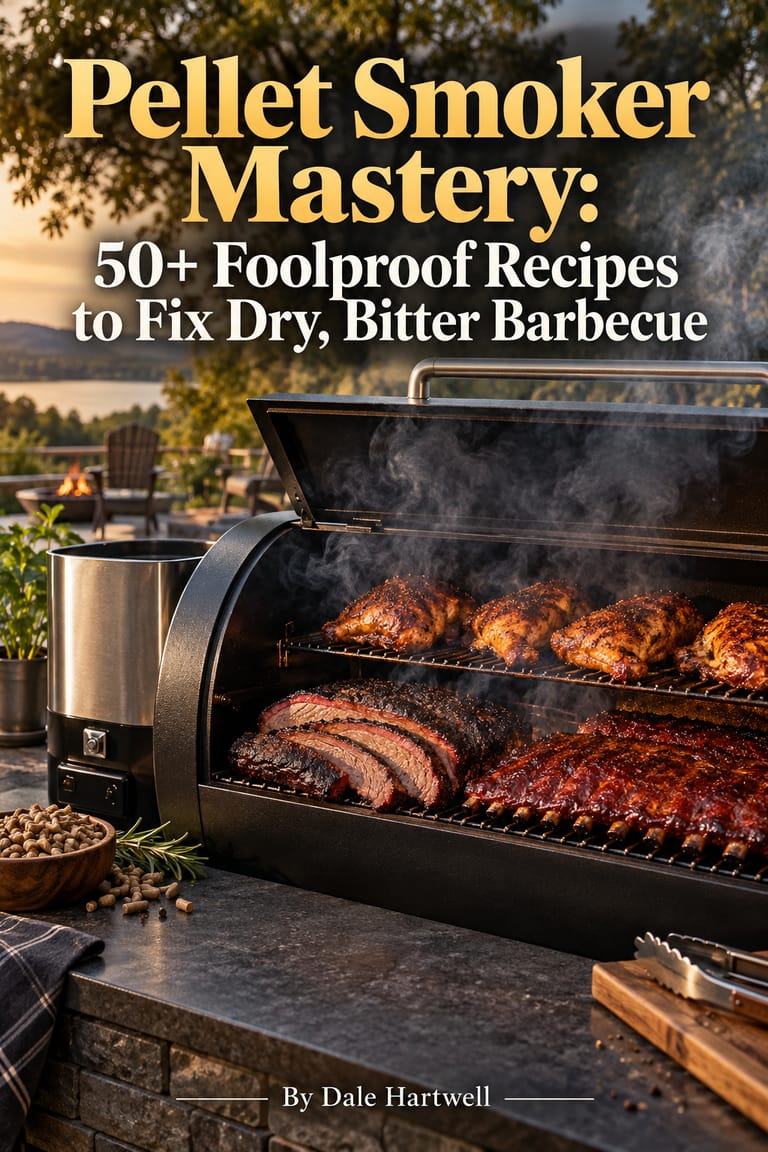
Open Pellet Smoker Mastery before your next fire.
Pellet Smoker Mastery: 50+ Foolproof Recipes to Fix Dry, Bitter Barbecue by Dale Hartwell connects fire-building, temperature and doneness guidance, wood-pellet pairings, and troubleshooting in one cookbook.
View the book on Amazon